From classical mechanics to general relativity

General relativity can be understood by examining its similarities with and departures from classical physics. The first step is the realization that classical mechanics and Newton's law of gravity admit a geometric description. The combination of this description with the laws of special relativity results in a heuristic derivation of general relativity.
Geometry of Newtonian gravityedit
At the base of classical mechanics is the notion that a body's motion can be described as a combination of free (or inertial) motion, and deviations from this free motion. Such deviations are caused by external forces acting on a body in accordance with Newton's second law of motion, which states that the net force acting on a body is equal to that body's (inertial) mass multiplied by its acceleration. The preferred inertial motions are related to the geometry of space and time: in the standard reference frames of classical mechanics, objects in free motion move along straight lines at constant speed. In modern parlance, their paths are geodesics, straight world lines in curved spacetime.
Conversely, one might expect that inertial motions, once identified by observing the actual motions of bodies and making allowances for the external forces (such as electromagnetism or friction), can be used to define the geometry of space, as well as a time coordinate. However, there is an ambiguity once gravity comes into play. According to Newton's law of gravity, and independently verified by experiments such as that of Eötvös and its successors (see Eötvös experiment), there is a universality of free fall (also known as the weak equivalence principle, or the universal equality of inertial and passive-gravitational mass): the trajectory of a test body in free fall depends only on its position and initial speed, but not on any of its material properties. A simplified version of this is embodied in Einstein's elevator experiment, illustrated in the figure on the right: for an observer in a small enclosed room, it is impossible for him to decide, by mapping the trajectory of bodies such as a dropped ball, whether the room is stationary in a gravitational field and the ball accelerating, or in free space aboard a rocket that is accelerating at a rate equal to that of the gravitational field versus the ball which upon release has nil acceleration.
Given the universality of free fall, there is no observable distinction between inertial motion and motion under the influence of the gravitational force. This suggests the definition of a new class of inertial motion, namely that of objects in free fall under the influence of gravity. This new class of preferred motions, too, defines a geometry of space and time—in mathematical terms, it is the geodesic motion associated with a specific connection which depends on the gradient of the gravitational potential. Space, in this construction, still has the ordinary Euclidean geometry. However, spacetime as a whole is more complicated. As can be shown using simple thought experiments following the free-fall trajectories of different test particles, the result of transporting spacetime vectors that can denote a particle's velocity (time-like vectors) will vary with the particle's trajectory; mathematically speaking, the Newtonian connection is not integrable. From this, one can deduce that spacetime is curved. The resulting Newton–Cartan theory is a geometric formulation of Newtonian gravity using only covariant concepts, i.e. a description which is valid in any desired coordinate system. In this geometric description, tidal effects—the relative acceleration of bodies in free fall—are related to the derivative of the connection, showing how the modified geometry is caused by the presence of mass.
Relativistic generalizationedit
As intriguing as geometric Newtonian gravity may be, its basis, classical mechanics, is merely a limiting case of (special) relativistic mechanics. In the language of symmetry: where gravity can be neglected, physics is Lorentz invariant as in special relativity rather than Galilei invariant as in classical mechanics. (The defining symmetry of special relativity is the Poincaré group, which includes translations, rotations and boosts.) The differences between the two become significant when dealing with speeds approaching the speed of light, and with high-energy phenomena.
With Lorentz symmetry, additional structures come into play. They are defined by the set of light cones (see image). The light-cones define a causal structure: for each event A, there is a set of events that can, in principle, either influence or be influenced by A via signals or interactions that do not need to travel faster than light (such as event B in the image), and a set of events for which such an influence is impossible (such as event C in the image). These sets are observer-independent. In conjunction with the world-lines of freely falling particles, the light-cones can be used to reconstruct the space–time's semi-Riemannian metric, at least up to a positive scalar factor. In mathematical terms, this defines a conformal structure or conformal geometry.
Special relativity is defined in the absence of gravity, so for practical applications, it is a suitable model whenever gravity can be neglected. Bringing gravity into play, and assuming the universality of free fall, an analogous reasoning as in the previous section applies: there are no global inertial frames. Instead there are approximate inertial frames moving alongside freely falling particles. Translated into the language of spacetime: the straight time-like lines that define a gravity-free inertial frame are deformed to lines that are curved relative to each other, suggesting that the inclusion of gravity necessitates a change in spacetime geometry.
A priori, it is not clear whether the new local frames in free fall coincide with the reference frames in which the laws of special relativity hold—that theory is based on the propagation of light, and thus on electromagnetism, which could have a different set of preferred frames. But using different assumptions about the special-relativistic frames (such as their being earth-fixed, or in free fall), one can derive different predictions for the gravitational redshift, that is, the way in which the frequency of light shifts as the light propagates through a gravitational field (cf. below). The actual measurements show that free-falling frames are the ones in which light propagates as it does in special relativity. The generalization of this statement, namely that the laws of special relativity hold to good approximation in freely falling (and non-rotating) reference frames, is known as the Einstein equivalence principle, a crucial guiding principle for generalizing special-relativistic physics to include gravity.
The same experimental data shows that time as measured by clocks in a gravitational field—proper time, to give the technical term—does not follow the rules of special relativity. In the language of spacetime geometry, it is not measured by the Minkowski metric. As in the Newtonian case, this is suggestive of a more general geometry. At small scales, all reference frames that are in free fall are equivalent, and approximately Minkowskian. Consequently, we are now dealing with a curved generalization of Minkowski space. The metric tensor that defines the geometry—in particular, how lengths and angles are measured—is not the Minkowski metric of special relativity, it is a generalization known as a semi- or pseudo-Riemannian metric. Furthermore, each Riemannian metric is naturally associated with one particular kind of connection, the Levi-Civita connection, and this is, in fact, the connection that satisfies the equivalence principle and makes space locally Minkowskian (that is, in suitable locally inertial coordinates, the metric is Minkowskian, and its first partial derivatives and the connection coefficients vanish).
Einstein's equationsedit
Having formulated the relativistic, geometric version of the effects of gravity, the question of gravity's source remains. In Newtonian gravity, the source is mass. In special relativity, mass turns out to be part of a more general quantity called the energy–momentum tensor, which includes both energy and momentum densities as well as stress: pressure and shear. Using the equivalence principle, this tensor is readily generalized to curved spacetime. Drawing further upon the analogy with geometric Newtonian gravity, it is natural to assume that the field equation for gravity relates this tensor and the Ricci tensor, which describes a particular class of tidal effects: the change in volume for a small cloud of test particles that are initially at rest, and then fall freely. In special relativity, conservation of energy–momentum corresponds to the statement that the energy–momentum tensor is divergence-free. This formula, too, is readily generalized to curved spacetime by replacing partial derivatives with their curved-manifold counterparts, covariant derivatives studied in differential geometry. With this additional condition—the covariant divergence of the energy-momentum tensor, and hence of whatever is on the other side of the equation, is zero—the simplest set of equations are what are called Einstein's (field) equations:
On the left-hand side is the Einstein tensor, , which is symmetric and a specific divergence-free combination of the Ricci tensor and the metric. In particular,


is the curvature scalar. The Ricci tensor itself is related to the more general Riemann curvature tensor as
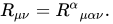
On the right-hand side, is the energy–momentum tensor. All tensors are written in abstract index notation. Matching the theory's prediction to observational results for planetary orbits or, equivalently, assuring that the weak-gravity, low-speed limit is Newtonian mechanics, the proportionality constant is found to be , where is the gravitational constant and the speed of light in vacuum. When there is no matter present, so that the energy–momentum tensor vanishes, the results are the vacuum Einstein equations,


In general relativity, the world line of a particle free from all external, non-gravitational force is a particular type of geodesic in curved spacetime. In other words, a freely moving or falling particle always moves along a geodesic.
The geodesic equation is:
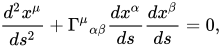
where is a scalar parameter of motion (e.g. the proper time), and are Christoffel symbols (sometimes called the affine connection coefficients or Levi-Civita connection coefficients) which is symmetric in the two lower indices. Greek indices may take the values: 0, 1, 2, 3 and the summation convention is used for repeated indices and . The quantity on the left-hand-side of this equation is the acceleration of a particle, and so this equation is analogous to Newton's laws of motion which likewise provide formulae for the acceleration of a particle. This equation of motion employs the Einstein notation, meaning that repeated indices are summed (i.e. from zero to three). The Christoffel symbols are functions of the four spacetime coordinates, and so are independent of the velocity or acceleration or other characteristics of a test particle whose motion is described by the geodesic equation.


Total force in general relativityedit
In the general relativity, the effective gravitational potential energy of an object of mass m rotating around a massive central body M is given by

A conservative total force can then be obtained ascitation needed

where L is the angular momentum. The first term represents the Newton's force of gravity, which is described by the inverse-square law. The second term represents the centrifugal force in the circular motion. The third term is related to the Coriolis force in the rotating reference frame, which includes the inverse of the distance to the fourth power.
Alternatives to general relativityedit
There are alternatives to general relativity built upon the same premises, which include additional rules and/or constraints, leading to different field equations. Examples are Whitehead's theory, Brans–Dicke theory, teleparallelism, f(R) gravity and Einstein–Cartan theory.

Comments
Post a Comment